
Day 2: All Possessives and Talking About Family
Overview
Self-Study Topic | Duration: 25–30 minutes
Level: Beginner
OBJECTIVE
By the end of this topic, you will be able to:
✔ Master all possessive pronouns.
✔ Describe family members in detail.
CONTENT
1. Self-check
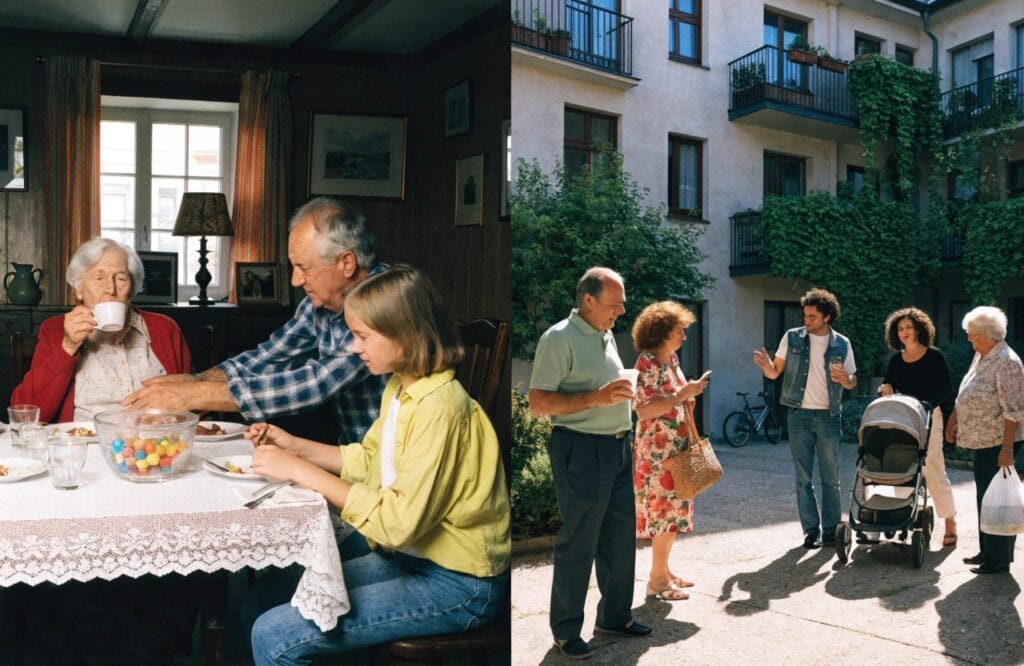
Regular self-testing helps retain new knowledge and skills. Before proceeding with the new topic, check what you have learned so far.
Task 1
Task 2
2. All Possessive Pronouns
Step 1: Grammatical Explanation
Pattern Rule:
Just like the indefinite article ein/eine/ein/eine, possessive pronouns add:
- No ending for masculine and neuter nouns
- -e for feminine and plural nouns (see below for exceptions
| English | German Base | Masculine (der) | Feminine (die) | Neuter (das) | Plural (die) |
| my | mein- | mein Vater | meine Mutter | mein Kind | meine Kinder |
| your (singular, informal) | dein- | dein Bruder | deine Schwester | dein Kind | deine Kinder |
| his / its | sein- | sein Onkel | seine Tante | sein Kind | seine Kinder |
| her | ihr- | ihr Sohn | ihre Tochter | ihr Kind | ihre Kinder |
| our | unser- | unser Opa | unsere Oma | unser Kind | unsere Kinder |
| your (plural, informal) | euer- | euer Vater | euere/eure Mutter | euer Kind | euere/eure Kinder |
| their | ihr- | ihr Cousin | ihre Cousine | ihr Kind | ihre Kinder |
| your (forma, singular & plural) | Ihr- | Ihr Bruder | Ihre Schwester | Ihr Kind | Ihre Kinder |
Grammar Note:
- euer loses the second e when endings are added: euer Bruder, euren Bruder. For feminine and plural, two forms are possible: euere OR eure Mutter.
- Formal Ihr is always capitalized.
- sein=his, refers to a male owner: Der Mann und sein Auto.
- ihr=her, refers to a female owner: Die Mutter und ihr Kind.
- sein=its, also refers to the neuter gender: Das Kind und sein Bruder.
Examples:
- Das ist sein Hund. (That is his dog.)
- Hier wohnt ihre Familie. (Here lives her family.)
- Unser Haus ist klein. (Our house is small.)
- Wo sind eure Kinder? (Where are your (pl.) children?)
- Ihre Tochter ist sehr klug. (Their daughter / Your (formal) daughter is very smart.)
Step 2: Detailed Examples with Family Vocabulary
- Study the table below.
- Listen to the audio clip to hear the correct pronunciation.
- Stop the audio clip and repeat until you have mastered the pronunciation.
- Learn the possessive pronouns with the family vocabulary by heart.
| Possessive | Singular Example | Plural Example |
| mein- | Das ist mein Vater. | Das sind meine Eltern. |
| dein- | Ist das dein Bruder? | Sind das deine Geschwister? |
| sein- | Sein Sohn heißt Paul. | Seine Kinder sind klein. |
| ihr- | Ihre Mutter ist Ärztin. | Ihre Tanten wohnen in Berlin. |
| unser- | Unser Opa ist alt. | Unsere Großeltern sind gesund. |
| euer- | Euer Onkel kommt heute. | Eure/euere Cousins sind nett. |
| ihr- | Ihr Hund ist süß. | Ihre Katzen sind grau. |
| Ihr- | Ihr Herr Schmidt, ist das Ihr Kind? | Ihre Kinder sind sehr klug. |
Important Usage Notes:
1. Distinguishing “ihr” (her) vs. “ihr” (their) vs. “Ihr” (your formal)
These three look similar but have different meanings:
| Word | Meaning | Example |
| ihr (lowercase) | her | Das ist ihr Bruder. (That is her brother.) |
| ihr (lowercase) | their | Das ist ihr Haus. (That is their house.) |
| Ihr (capitalized) | your (formal) | Ist das Ihr Koffer, Herr Müller? (Is that your suitcase, Mr. Müller?) |
Context tells you which one it is!
2. Possessive Pronouns in the Accusative Case (Preview)
Just like ein becomes einen for the masculine accusative, possessives also change for the masculine:
| Nominative | Accusative (masculine only) | Example |
| mein Bruder | meinen Bruder | Ich sehe meinen Bruder. |
| dein Vater | deinen Vater | Sie liebt deinen Vater. |
| sein Hund | seinen Hund | Er hat seinen Hund. |
(We’ll practice this more in Week 4!)
Step 3: Practice
Exercise 1: Choose the correct possessive form to complete each sentence.
Exercise 2: Fill in the blanks.
Exercise 3: Change each sentence from singular to plural. Pay attention to both the possessive and the noun.
Watch our educational video
3. Talking About Family in Detail
Step 1: combine possessives with other familiar language
Study the examples below:
- Age: Meine Schwester ist 15 Jahre alt. Wie alt ist dein Bruder?
- Name: Sein Vater heißt Klaus. Ihre Mutter heißt Maria.
- Description: Unser Opa ist alt, aber gesund. Eure Cousine ist wirklich nett.
- Job: Meine Tante ist Lehrerin. Sein Onkel arbeitet als Arzt.
- Location: Ihre Großeltern wohnen in München. Unsere Familie lebt in Österreich.
Step 2: Practice
Exercise 1: Choose the correct possessive
Exercise 2: Complete the family portrait description
Family: Thomas (father), Maria (mother), Lukas (son, 10), Anna (daughter, 7), Opa Hans (grandfather).
Listen to our educational song and sing Along
Click here for a simple reading comprehension exercise.
Familie ist verrückt – Leseverstehen
Read the short song text and answer the questions.
Lied
Mein Vater tanzt im Bad.
Meine Mutter lacht laut und macht Salat.
Dein Bruder schläft im Zug.
Deine Schwester sagt: „Ich esse nur Kuchen!“
Sein Onkel singt falsch.
Seine Tante tanzt Samba mit einem Lachs.
Ihr Sohn isst Eis im Bett.
Ihre Tochter liest nicht – sie tanzt auf dem Sofa!
Unser Opa fährt zu schnell Fahrrad.
Unsere Oma ruft: „Langsam, bitte!“
Euer Vater kocht Suppe mit einem Schuh.
Eure Mutter sagt: „Nein, das ist tabu!“
Ihr Cousin kommt mit Hut.
Ihre Cousine tanzt im Garten.
Ihr Bruder liest laut.
Ihre Schwester sagt: „Psst!“
4. Homework & Preview FOR TOMORROW
Homework
- Writing: Write a paragraph (6-10 sentences) describing your family and relatives. Use all possessive pronouns. Use our educational song “Familie ist verrückt” as inspiration.
- Speaking: Record a short video or audio (about 60 seconds) where you describe your family and relatives, using your written paragraph as a guide.
PREVIEW
Tomorrow moves from family to everyday life: daily routines, time expressions, and present tense action verbs.
Strong progress today. You have learned how to connect grammar to real people and real relationships.
word of encouragement
This builds confidence, and shows that your foundation is becoming solid.