
Day 3: My Clothes – Indefinite Articles & Colors
Overview
Self-Study Topic | Duration: 25–30 minutes
Level: Absolute Beginner
OBJECTIVE
By the end of this topic, you will be able to:
✔ Use indefinite articles (ein, eine) to talk about clothes.
✔ Name common colors in German.
✔ Describe what you are wearing.
CONTENT
1. Self-check
Regular self-testing helps retain new knowledge and skills. Before proceeding with the new topic, check what you have learned so far.
The Perfect Room
Read the description of an ideal room and select the correct words to complete the sentences.
2. Indefinite Articles in Singular & “No Article” in Plural
Step 1: Grammatical Explanation
- The indefinite article (“a” or “an” in English) changes based on the gender of the noun.
- In the plural, when we say “some” or mention things without an article (like “I have books”), we use no article at all.
Below is an overview of German indefinite and definite articles.
| English | Masculine | Feminine | Neuter | Plural (“some”/ø) |
|---|---|---|---|---|
| a / an | ein | eine | ein | – (no article) |
| the | der | die | das | die |
Examples with Clothes:
- masculine: ein Pullover (a sweater) / der Pullover (the sweater)
- feminine: eine Jacke (a jacket) / die Jacke (the jacket)
- neuter: ein T-Shirt (a T-shirt) / das T-Shirt (the T-shirt)
- plural: Pullover (sweaters) / die Pullover (the sweaters)
More Typical Clothing Items:
- Masculine (ein/der): der Schuh (shoe), der Rock (skirt), der Mantel (coat), der Anzug (suit), der Hut (hat)
- Feminine (eine/die): die Bluse (blouse), die Mütze (cap), die Weste (vest), die Hose (pants, trousers)
- Neuter (ein/das): das Kleid (dress), das Hemd (shirt), das Sakko (blazer), das T-Shirt (T-shirt)
Important Note: The word for “not (a)/no/none” is kein (masculine/neuter) or keine (feminine/plural).
- Das ist ein Pullover. (It is a sweater.) – Das ist kein Pullover. (It is not a sweater.)
- Das ist eine Jacke. (It is a jacket.) – Das ist keine Jacke. (It is not a jacket.)
- Das ist ein T-Shirt. (It is a T-shirt.) – Das ist kein T-Shirt. (It is not a T-shirt.)
- Das sind Hüte. (These are hats.) – Das sind keine Hüte. (These are not hats.)
Step 2: Practice
Exercise 1: Fill in the blanks.
Exercise 2: Listen and repeat
Remember to always learn German nouns with the definite article. In this way, you will always know which gender they belong to.
Also, learning words in complete sentences will help you retain the new vocabulary.

3. Colors
Step 1: Learn Colors (Farben)
- Here are common colors to describe your clothes.
- When used after “sein” (ist/sind), they do not change!
| German | English |
|---|---|
| weiß | white |
| schwarz | black |
| rot | red |
| blau | blue |
| grün | green |
| gelb | yellow |
| orange | orange |
| lila | purple |
| rosa | pink |
| grau | gray |
| braun | brown |
Example Sentences:
- Mein Pullover ist blau. (My sweater is blue.)
- Die Hose ist schwarz. (The pants are black.)
- Das T-Shirt ist rot. (The T-shirt is red.)
Step 2: Listen and repeat
Listen to the audio file, stop the recording if necessary, and repeat.
Learn all the colors by heart, as you will use them frequently to describe various things.
Step 3: Practice
Exercise 1
Practice the common adjectives on Quizlet. You may need to create an account there for full access.
Exercise 2
What are these colors in German? Choose the correct option.
Exercise 3
Solve the crossword.
Copy this letter if you do not have it on your keyboard: ß
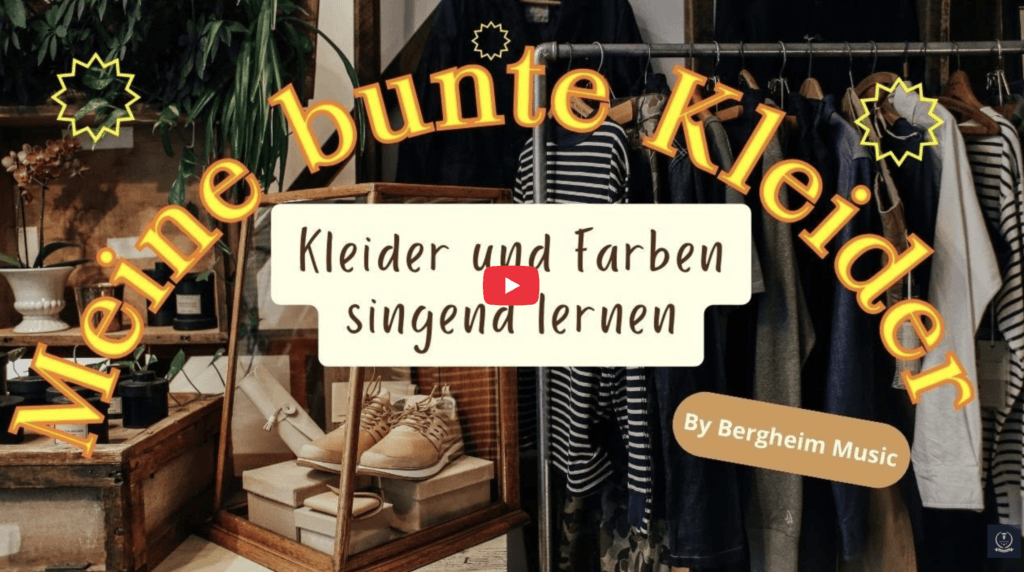
Listen to our educational song and sing Along
4. Homework & Preview FOR TOMORROW
Homework
- Writing: Describe your clothes using the colors you have learned.
- Listening: Watch our clothes-and-colors song again and sing along.
- Speaking: Record yourself describing your clothes and their colors.
PREVIEW
Tomorrow, we’ll learn to talk about the things we possess in the accusative case.
Fantastic work!
word of encouragement
Now you can talk about your clothes and their colors.
You’re building a very practical vocabulary for everyday life!